
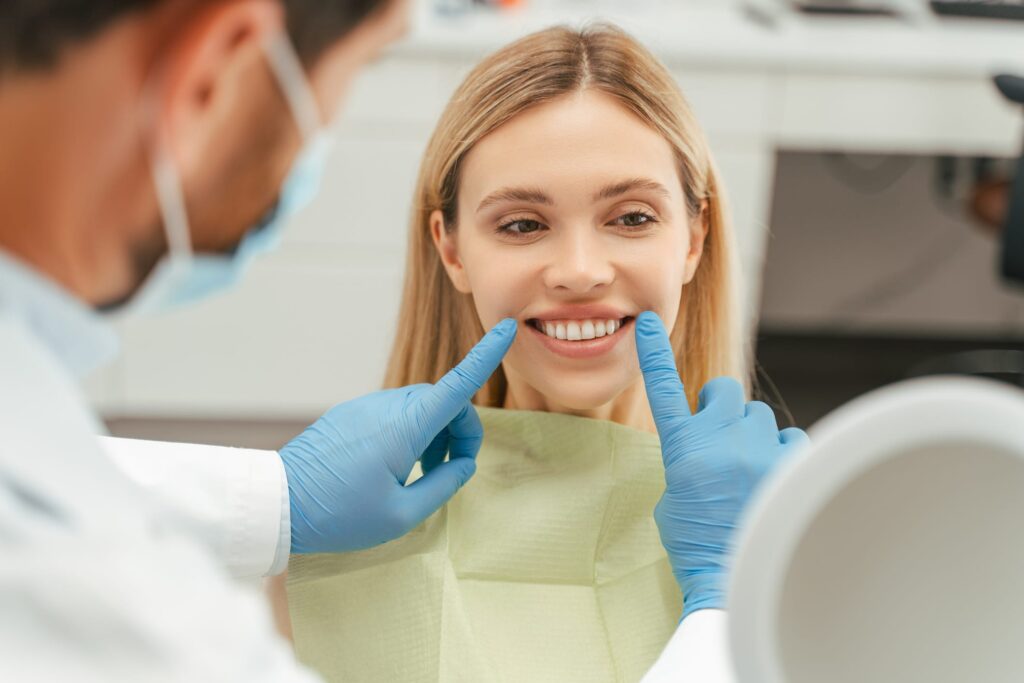
Removing surface stains during a dental cleaning at Cary Towne Dental is a mechanical process that eliminates exterior discoloration caused by coffee and tea. Clinical literature suggests that extrinsic stains are largely related to an individual’s personal habits [1] (Khan et al., 2014). In contrast, professional teeth whitening is a chemical treatment designed to bleach intrinsic stains and lighten the underlying shade of your enamel.
The Blueprint for Brighter Teeth: Why Sequence Matters
If you want the best possible return on your cosmetic investment, the order of your treatments matters. You cannot successfully chemically whiten a tooth that is covered in sticky plaque or hardened tartar. Plaque acts as a stubborn physical barrier. If you apply bleaching gel over this barrier, the peroxide cannot reach your natural enamel. This results in a patchy, uneven appearance. Scheduling your professional teeth cleaning right before your whitening treatment gives your dentist a blank canvas. By using ultrasonic tools to clear away the physical debris first, we ensure the whitening gel is in direct, even contact with every surface of your tooth. This sequential approach produces a brighter, more uniform result. Medical evidence shows that hand or ultrasonic scaling removes calculus and bacterial deposits subgingivally [2] (Oza et al., 2022).
How Dental Restorations React to Whitening and Polishing
Patients often ask if their existing dental work will change color during a cosmetic treatment. Porcelain crowns, dental veneers, and composite fillings do not respond to chemical whitening gels. If you chemically bleach your natural teeth, your existing dental restorations will stay the exact same color, which can make them look mismatched. However, professional teeth polishing does benefit your dental work. Clinical evidence indicates that tooth polishing gives a polished and aesthetic appearance by removing plaque and extrinsic stains [3] (Sawai et al., 2015). While a cleaning will not change the baseline color of a crown, specialized polishing paste can lift dark coffee and wine stains from the surface of your porcelain. If you plan to upgrade your smile and already have restorations, Dr. Prahalad will help you map out a custom plan to ensure your natural teeth and dental work match perfectly.
Enamel Thickness: The Biological Secret to a White Smile
Sometimes, the color of your teeth has nothing to do with what you drink. It comes down to your unique biology. Your tooth is made of two main layers: the hard, white outer enamel and the softer, yellowish dentin underneath. If you grind your teeth at night or brush too aggressively with a hard-bristled toothbrush, your white enamel naturally thins out over time. As the enamel gets thinner, the yellow dentin begins to show through. A mechanical teeth cleaning cannot fix this type of yellowing because there are no surface stains to scrape away. In this scenario, professional chemical whitening is the only way to penetrate the tooth and neutralize the yellow dentin, restoring a youthful, bright appearance.
Comparisons: Erasing Stains vs. Chemical Bleaching
Understanding your clinical options ensures you spend your time and budget wisely. Here is how standard stain removal compares to active chemical whitening.
Treatment Strategy | Primary Clinical Focus | Cost Predictability | Durability & Maintenance Level |
Mechanical Dental Cleaning | Sweeps away plaque, tartar, and exterior extrinsic stains. | Low. Often fully covered by dental insurance. | Moderate. Surface stains return in 3–6 months depending on diet. |
In-Office Professional Whitening | Chemically bleaches deep intrinsic stains for immediate results. | Moderate. Elective cosmetic procedure. | High. Lasts 1–3 years with good oral hygiene and limited dark liquids. |
Take-Home Custom Whitening | Gradual chemical bleaching using custom-fitted trays. | Moderate. Highly cost-effective over time. | High. You can easily maintain your shade at home using touch-up gel. |
The Role of Hydration in Preventing Future Coffee Stains
Once you achieve a bright smile, you want to protect it. You do not have to give up your favorite morning brew to keep your teeth looking great. Your body actually has a natural defense system against extrinsic stains: your saliva. Saliva is always washing over your teeth, neutralizing acids and taking away dark pigments before they can stick to your enamel permanently. Dehydration reduces saliva production, making your teeth much more vulnerable to staining. To combat this, just have a glass of Wake County tap water with your daily coffee or tea. This simple habit keeps your mouth hydrated, boosts your protective saliva flow, and stops new surface stains from forming between your professional cleanings.
Combining In-Office and At-Home Care for Lasting Results
Achieving a brilliant smile is only the first step; maintaining it requires a smart strategy. Many patients achieve the best, longest-lasting results by using a hybrid approach to cosmetic care. First, we utilize an in-office professional whitening session to lift deep intrinsic stains quickly and safely. Then, we provide you with custom-fitted whitening trays to take home. Because these trays are molded to the exact shape of your teeth, they keep a lower-dose peroxide gel secured against your enamel without irritating your gums. By doing a quick touch-up at home every few months, you lock in your new shade. This proactive strategy keeps your smile bright year-round and reduces your need for frequent in-office treatments.
FAQS
1. Why do my teeth still look yellow after a professional cleaning?
A cleaning only removes surface buildup. If your teeth still appear yellow after a thorough polish, the discoloration is intrinsic (inside the tooth), or your natural dentin is showing through thin enamel. You will need a chemical whitening treatment to lighten the actual shade of the tooth.
2. Should I get my teeth cleaned before or after a whitening treatment?
Always schedule your cleaning before you whiten your teeth. If you try to whiten teeth covered in plaque or tartar, the bleaching gel can’t reach your enamel, resulting in a patchy, uneven finish.
3. Are over-the-counter whitening strips as effective as professional treatments?
No. Over-the-counter strips use a very weak concentration of peroxide and only cover the front six teeth.
References
[1] Khan, M. K., Bokhari, S. A., Haleem, A., Kareem, A., Khan, A. A., Hosein, T., & Khan, M. U. (2014). Extrinsic stain removal with a toothpowder: A randomized controlled trial. International journal of health sciences, 8(3), 269–274. https://doi.org/10.12816/0023979
[2] Oza, R. R., Sharma, V., Multani, P., Balsara, K., Bajaj, P., & Dhadse, P. (2022). Comparing the Effectiveness of Ultrasonic Instruments Over Manual Instruments for Scaling and Root Planing in Patients With Chronic Periodontitis: A Systematic Review and Meta-Analysis. Cureus, 14(11), e31463. https://doi.org/10.7759/cureus.31463
[3] Sawai, M. A., Bhardwaj, A., Jafri, Z., Sultan, N., & Daing, A. (2015). Tooth polishing: The current status. Journal of Indian Society of Periodontology, 19(4), 375–380. https://doi.org/10.4103/0972-124X.154170