
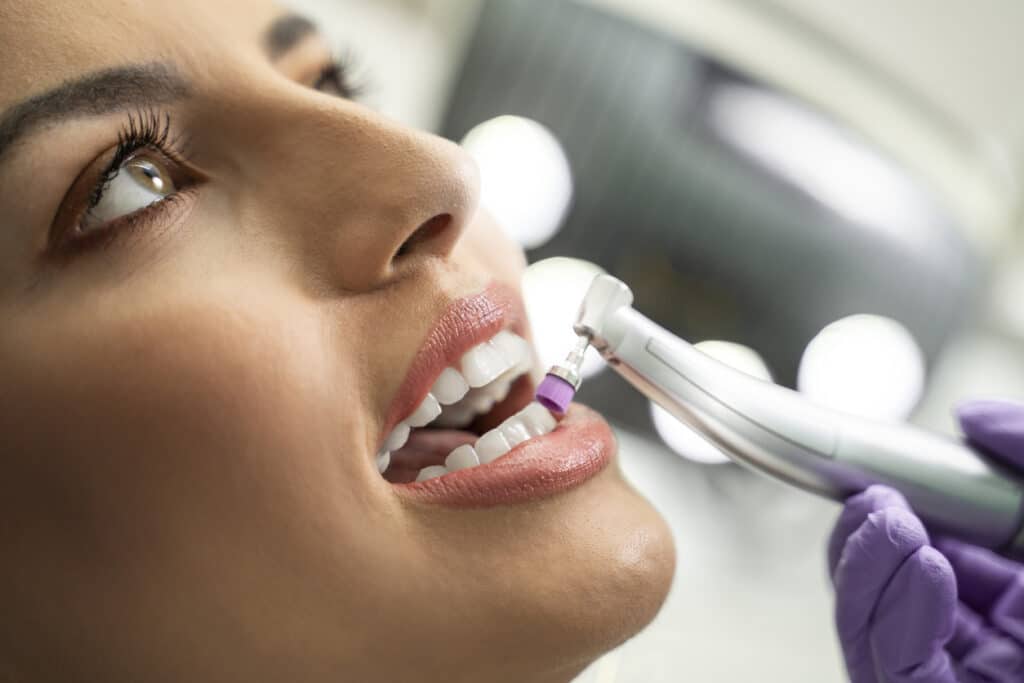
Teeth polishing is a specific finishing step of a professional dental cleaning that involves a motorized rubber cup and a mildly abrasive paste to remove surface stains and smooth your enamel. The medical literature indicates that tooth polishing smooths tooth surfaces so that plaque and bacteria cannot adhere to them easily [1] (Sawai et al., 2015). This helps to keep harmful plaque from easily reattaching to your teeth and keeps your smile brighter and healthier.
Professional Prophy Paste vs. At-Home Whitening Toothpaste
You might wonder why you cannot just scrub away daily coffee stains at home. Many commercial whitening toothpastes contain harsh abrasives. If you use them every day, they can permanently scratch and wear down your natural enamel. At Cary Towne Dental, our professional polishing paste (prophy paste) is formulated with specific grit levels, ranging from fine to coarse. Additionally, clinical literature supports that while polishing pastes did not influence the microhardness of resin composites, they improved surface roughness, gloss, and color stability [2] (Büyükpolat et al., 2025). Your hygienist carefully selects the exact grit needed for your unique stains. This targeted approach safely whitens your teeth during your biannual visit without the long-term damage of harsh drugstore products.
Contemporary Techniques: Rubber Cup Versus Air Polishing
Dentistry has more than one way to get a smooth smile. The traditional way is to use a small spinning rubber cup to apply the polishing paste. If, however, you have deep grooves on your molars, tightly spaced teeth, or wear orthodontic clear aligner attachments, we may use an air-polishing system. Clinical evidence supports the use of air polishing devices in patients needing supportive periodontal therapy, with better patient comfort compared to conventional techniques [3] (Tan et al., 2022). This modern device sprays a fine, pressurized stream of warm water and specialty powders, such as glycine or sodium bicarbonate, right on your teeth. It quickly rinses away hidden plaque and stubborn stains in hard-to-reach areas, giving you a highly customized and gentle clean.
Comparisons: Polishing vs. Scaling vs. Whitening
Patients often confuse the different parts of a dental visit. Here is how polishing compares to other common treatments you might receive at our Cary clinic.
|
Treatment Type |
Primary Purpose |
Anticipated Cost Impact |
Durability & Maintenance Level |
|
Teeth Polishing |
Smooths enamel and removes light surface stains. |
Included in standard cleaning fee. |
Moderate. Lasts until new plaque/stains build up (usually 3–6 months). |
|
Dental Scaling |
Removes hardened, destructive tartar beneath the gums. |
Included in standard cleaning fee. |
High. Protects bone and gums; maintained with daily flossing. |
|
Cosmetic Whitening |
Chemically bleaches deep intrinsic stains inside the tooth. |
Moderate to High out-of-pocket cost. |
Long-term. Lasts 1–3 years depending on your diet and habits. |
Managing Tooth Sensitivity During Your Polish
If drinking a glass of ice water makes you wince, you might feel anxious about any dental tool touching your teeth. We understand that tooth sensitivity is a real barrier to getting the care you need. If your teeth are sensitive, please let your hygienist know before we begin. We can easily adapt the process for your comfort. We might switch to a fine-grit desensitizing paste, use a lighter touch, or skip polishing the specific areas where your gums have naturally receded. Your comfort is our priority, and you are always in control of your appointment pace.
Post-Polishing Care: Keeping Your Enamel Smooth
When you leave our office on Towne Village Drive, your teeth will feel slick. You want to protect that fresh feeling for as long as possible. For the first 24 hours after your polish, try to avoid dark, staining liquids like black tea, red wine, or heavy espresso. When we polish your teeth, a microscopic protein layer over your enamel (called the pellicle) is temporarily removed. Until this natural layer reforms a day later, your teeth are slightly more prone to absorbing deep colors. Stick to lighter-colored foods and your standard brushing routine to lock in your bright results.
Gentle Teeth Polishing for Younger Smiles
Parents often ask if growing toddlers and teens need their teeth polished. The answer depends on your child’s specific oral health. Because children generally do not consume staining foods like coffee or tea, we often use a very soft bristle brush rather than a traditional rubber cup. We apply a gentle, kid-friendly paste to sweep away soft plaque. This modified step helps kids get comfortable with the quiet buzzing sensation of dental tools. By making the polishing phase quick and painless, we help your child build immediate trust and conquer early dental anxiety.
FAQS
1. Are teeth polishings necessary during every dental cleaning?
Not always. In modern dentistry, we follow a practice called “selective polishing.” If you maintain excellent home hygiene and have no visible stains or plaque buildup, we may skip polishing certain teeth. Prophy paste is mildly abrasive, and over-polishing perfectly clean teeth over many years can unnecessarily wear down a microscopic layer of enamel. We tailor the polish exactly to what your mouth needs.
2. Does polishing damage my tooth enamel?
No, when performed by a trained dental professional, polishing is perfectly safe. We use specific fine-grit pastes and apply careful pressure, so we only remove stains and soft plaque, leaving your healthy enamel strong and intact.
3. Does polishing teeth whiten my smile?
Polishing will brighten your teeth by removing superficial extrinsic stains (such as coffee or wine stains). But it does not change the natural underlying color of your teeth. If you want to alter the actual shade of your smile, ask us about professional chemical whitening options.
References
[1] Sawai, M. A., Bhardwaj, A., Jafri, Z., Sultan, N., & Daing, A. (2015). Tooth polishing: The current status. Journal of Indian Society of Periodontology, 19(4), 375–380. https://doi.org/10.4103/0972-124X.154170
[2] Büyükpolat, M., Aydın, N., Eryılmaz, B., Karaoğlanoğlu, S., & Ersöz, B. (2025). The effect of polishing pastes on the surface roughness, microhardness, gloss, and color change of resin composites. BMC oral health, 26(1), 87. https://doi.org/10.1186/s12903-025-07471-4