
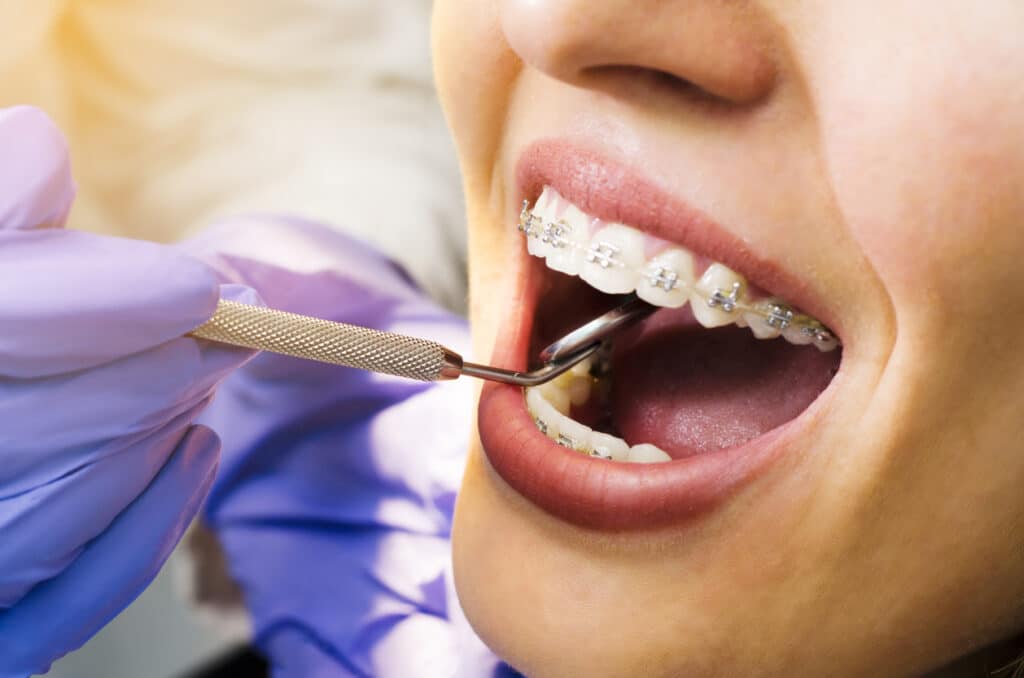
The medical literature supports the importance of maintaining good oral hygiene during orthodontic treatment, as poor oral hygiene can cause adverse effects [1] (Guo et al., 2020). A dental cleaning with orthodontics is a special preventive hygiene visit designed to safely remove plaque, tartar, and bacteria from around braces, wires, and clear aligner attachments. This special care helps prevent tooth decay and white spot lesions, protecting your enamel while your teeth move into the correct position.
The Threat of White Spot Lesions (And How Cleanings Prevent Them)
One of the biggest risks during orthodontic treatment is decalcification. When plaque sits undisturbed around your brackets or underneath your clear aligner attachments, the bacteria produce acid. This acid pulls calcium out of your enamel. As a result, white squares on your teeth become notably visible the day of your braces removal. Routine professional cleanings stop this process in its tracks. By thoroughly removing the sticky biofilm that your toothbrush misses, we eliminate the source of the acid. Medical evidence supports the effectiveness of both infiltrating resin and fluoride varnish in treating white spot lesions [2] (Lopes et al., 2024). Then we follow up with a concentrated fluoride treatment that seeps into the enamel and remineralizes weak spots before those white marks become permanent.
Advanced Hygiene Tools Designed for Braces
Cleaning around orthodontic appliances takes more than your regular dental hygiene tools. At Carytowne Dental, we take a personalized approach to hygiene to fit your needs. Instead of traditional metal hand scalers, we often use ultrasonic technology. Clinical literature supports using curved-bristled toothbrushes, triple-headed toothbrushes, orthodontic toothbrushes, and other toothbrush adaptations when cleaning around braces [3] (Goh et al., 2018). An ultrasonic scaler uses high-frequency vibrations and a gentle stream of water to flush out tartar hidden beneath your archwires. Because this tool relies on vibration rather than physical scraping, it cleans your teeth thoroughly without tugging on your brackets or causing discomfort to your shifting roots. We also use precision air-polishing systems to safely blast away stubborn coffee or tea stains from the tiny crevices of your hardware.
Comparisons: Hygiene Needs Based on Your Orthodontic Plan
Every orthodontic path requires a unique hygiene strategy. Here is how your daily and professional maintenance will vary based on your treatment.
Treatment Phase | Cleaning Complexity | Professional Maintenance Schedule | At-Home Routine Impact |
Traditional Braces | High. Wires and brackets trap plaque easily. | Every 3 to 4 months recommended. | Requires floss threaders, water flossers, and careful brushing. |
Clear Aligners (Invisalign) | Moderate. Attachments require specific attention. | Standard 6-month visits (unless prone to decay). | Must brush after every meal before re-inserting trays. |
Standard Dentition (No Ortho) | Baseline. Smooth enamel surfaces. | Every 6 months. | Brush twice daily and floss with string floss. |
Timing is Everything: Coordinating Cleanings with Your Orthodontist
Many patients wonder when they should schedule cleanings during active treatment. If you wear traditional braces, the most effective strategy is to book your dental cleaning on the same day as your orthodontic adjustment. If your orthodontist takes your wires off, you can drive over to our office for a completely unobstructed cleaning, then return to get your new wires placed. If that timeline does not work for your schedule, do not worry. Our hygienists are experts at navigating around fully assembled braces. If you are an Invisalign patient, simply bring your current set of trays to your appointment. We will professionally clean your teeth, polish your attachments, and ensure your aligners still fit perfectly before you leave the chair.
Upgrading Your At-Home Routine for Shifting Teeth
What you do in your own bathroom between professional visits dictates the success of your orthodontic hygiene. Standard string floss is notoriously difficult to thread under a metal wire, often leading patients to skip flossing altogether. To protect your gums, we strongly recommend investing in a high-quality water flosser. A targeted stream of water effortlessly flushes out food particles trapped between your brackets. Additionally, keep a pack of interdental brushes in your bag or desk. These are perfect for quickly scrubbing the sides of your brackets after a mid-day snack, keeping your enamel clean and your breath fresh throughout the workday.
Diet Tweaks That Simplify Your Orthodontic Hygiene
Your diet directly impacts how hard you have to work to keep your teeth clean. Sticky, starchy, or sugary foods act like glue when they interact with braces. A handful of potato chips or a sticky candy bar leaves residue tightly packed around your brackets and speeds up plaque buildup. Feed your teeth with smart eating habits. We recommend water-rich vegetables and lean proteins that typically don’t stick to your teeth. The next time you are having lunch at Crossroads Plaza or grabbing a quick smoothie after a workout, make a habit of rinsing your mouth out with tap water right afterward. This simple act removes residual sugars and balances out the pH in your mouth until you can brush properly.
FAQS
1. Can I have my teeth cleaned if I wear braces or Invisalign?
Yes. Professional cleanings are more important than ever when you have orthodontics, in fact. Our trained hygienists are able to safely clean around your brackets, wires, and clear aligner attachments without damaging your braces or impeding your tooth movement.
2. Do I need to take my Invisalign attachments off for a normal cleaning?
Nope. Your Invisalign attachments, the little bumps the color of your teeth that are on your teeth, remain intact. Special polishing tools make cleaning around these attachments easy, so they stay free of stains and plaque, and your aligners fit perfectly.
3. Will my dental cleaning hurt when my teeth are moving?
They can feel sensitive if your teeth are moving around. We get that. Our team uses a gentle touch and can adjust our water temperature and scaling pressure to keep you perfectly comfortable throughout the entire visit.
References
[1] Guo, J., Li, L., Guan, G., Bennani, F., & Mei, L. (2020). Oral health knowledge and practice among orthodontic clients in China and New Zealand. Canadian journal of dental hygiene : CJDH = Journal canadien de l’hygiene dentaire : JCHD, 54(3), 124–132.
[2] Lopes, P. C., Carvalho, T., Gomes, A. T. P. C., Veiga, N., Blanco, L., Correia, M. J., & Mello-Moura, A. C. V. (2024). White spot lesions: diagnosis and treatment – a systematic review. BMC oral health, 24(1), 58. https://doi.org/10.1186/s12903-023-03720-6
[3] Goh, H. H., & Doubleday, B. (2018). Aids for mechanical cleaning of teeth with fixed braces. The Cochrane Database of Systematic Reviews, 2018(1), CD012931. https://doi.org/10.1002/14651858.CD012931