
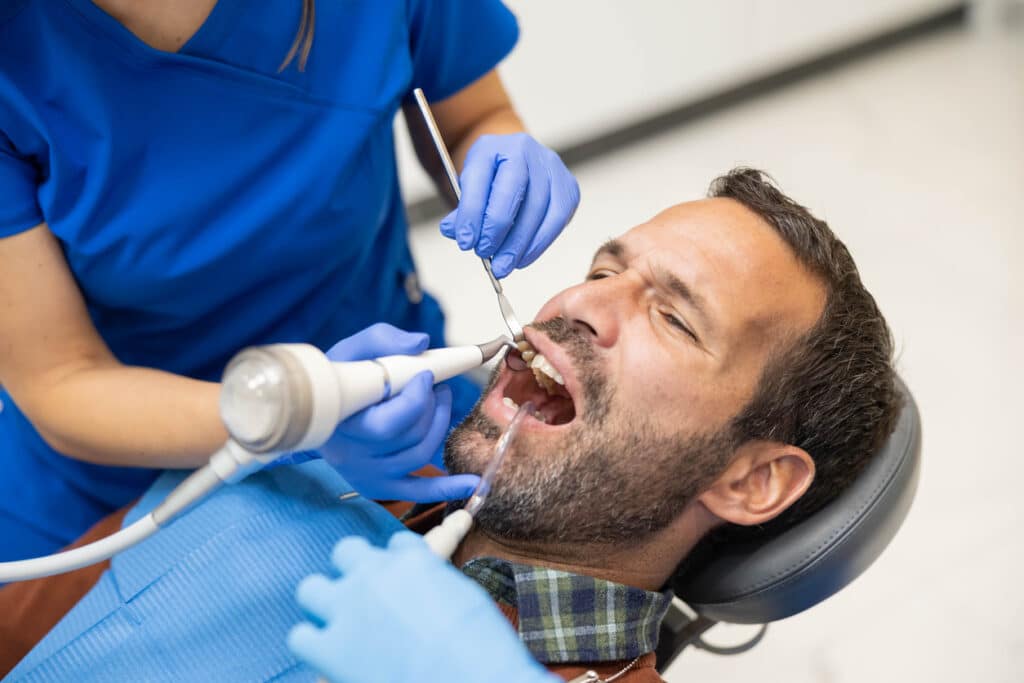
A deep dental cleaning, clinically known as scaling and root planing, is a therapeutic procedure that removes hardened plaque and bacterial toxins from beneath the gum line. Clinical literature shows that polishing smooths the tooth surface, making it harder for bacteria to stick [1] (Informed Health, 2023). Scaling and deep cleaning are indicated when active periodontal disease has resulted in deepened gum pockets with calculus below the gumline and clinical attachment loss.
Sign 1: Your Gums Bleed During Routine Brushing
Seeing a pink tint when you spit out your toothpaste is often the very first sign of an active oral infection. Many patients brush this off, assuming they just flossed too hard or used a stiff toothbrush. However, healthy gum tissue is highly resilient and should rarely bleed during your standard daily routine. When you skip flossing, soft bacterial plaque accumulates along your gumline. Within 48 hours, this soft plaque hardens into a tough substance called calculus. This calculus acts like a physical splinter trapped inside your gums. Your immune system responds to this bacterial “biofilm” by increasing blood flow to the area, causing local tissue swelling and gum fragility. Medical evidence indicates that bleeding on brushing (BoB) is an important sign of gingival inflammation [2] (Tonetti et al., 2020). The bleeding you see is actually the result of microscopic ulcerations inside your gum tissue. Because a standard dental cleaning only polishes the tooth above the gumline, you need a therapeutic deep cleaning to physically remove the calculus “splinter” so your tissue can finally heal.
Sign 2: Your Gum Pockets Measure 4 Millimeters or Deeper
During a comprehensive exam at Cary Towne Dental, you will hear your hygienist call out a series of numbers. We use a small, specialized ruler called a periodontal probe to measure the natural gum tissue around each tooth. This is a critical diagnostic step for your long-term health. A healthy, tight gum pocket measures between 1 and 3 millimeters deep. When calculus builds up below the gumline, the bacteria produce toxins that destroy the tissue connecting your gums to your teeth. The pocket then drops to 4, 5, or even 6 millimeters deep. Of note, toothbrush bristles and standard dental floss typically reach about 3 millimeters beneath the gums. Once a pocket reaches 4 millimeters, it creates a dark, oxygen-free space where destructive bacteria thrive perfectly out of your reach. Clinical evidence indicates that patients with residual periodontal pockets ≤4 mm after active periodontal therapy are more likely to present stability of clinical attachment level [3] (Pilloni et al., 2021). A deep cleaning is the only clinical way to flush out these deep pockets.
Sign 3: You Experience Persistent Bad Breath That Mouthwash Cannot Fix
We all experience morning breath after a cup of coffee, but periodontal halitosis is distinctly different. If you are constantly chewing mints, using strong mouthwash, and brushing your tongue, but you still have a bad taste in your mouth, there likely is an alternative cause of your bad breath. . The bacteria that cause gum disease survive by breaking down proteins in your mouth. As they break down these proteins, they produce volatile sulfur compounds (VSCs) as a by-product. These compounds have a strong, persistent odor that is quite metallic or sour. Over-the-counter mouthwashes temporarily mask the odor. They cannot penetrate the hardened tartar that protects the bacteria. Deep cleaning with ultrasonic scaling safely shatters the tartar and neutralizes the sulfur-producing bacteria at the source, freshening your breath over the subsequent days to weeks.
Comparisons: Finding Your Correct Level of Care
Understanding your clinical needs helps you plan your health journey effectively. Here is how a deep cleaning compares to other common hygiene visits.
Care Level | Clinical Purpose | Cost Predictability | Durability & Maintenance Level |
Standard Cleaning (Prophylaxis) | Removes soft plaque above the gumline for healthy mouths. | Low. Generally covered 100% by preventive insurance. | High. Maintained with standard 6-month checkups and daily brushing. |
Deep Cleaning (Scaling & Root Planing) | Removes hardened subgingival calculus to halt active bone loss. | Moderate. Billed per quadrant; often covered at 50-80% by insurance. | Long-term stability achievable. Requires a strict 3-to-4 month maintenance schedule. |
Periodontal Maintenance | Ongoing therapeutic care following a deep cleaning to prevent relapse. | Low to Moderate. | High. Performed every 90 to 120 days to disrupt new bacterial colonies. |
Sign 4: Sudden Root Sensitivity to Hot and Cold Temperatures
Enjoying a cold glass of iced tea on a warm Wake County afternoon should not cause a sharp jolt of pain in your mouth. While a cavity can cause temperature sensitivity, it often results from untreated gum disease that causes tissue recession. As subgingival tartar pushes your gums downward, the natural root of your tooth becomes exposed. Your tooth’s crown is protected by a durable layer of white enamel. Your roots, however, are only covered by a much softer, porous material called cementum. Underneath the cementum are thousands of microscopic nerve pathways. When your gums recede and expose these pathways, cold drinks or breaths of crisp air travel straight to the center of your tooth. A deep cleaning removes the tartar that causes gum recession, halting the recession and allowing your dental team to apply targeted desensitizing treatments to the exposed roots.
Sign 5: Your Bite Feels Different, or Teeth Begin to Shift
Your teeth are not rigidly fused to your jaw. They are suspended in the bone by a dynamic network of ligaments. When periodontal disease advances past the soft gum tissue, the chronic inflammation begins to actively dissolve your jawbone. This process is medically known as osteoclastic activity. As the supporting bone is decayed, the foundation holding your teeth becomes compromised. You might notice that a specific tooth feels slightly loose when you gently push it with your tongue. You may also feel your teeth do not fit together the same way when you chew your dinner. If you notice these subtle shifts, time is critical. Bone loss is permanent, and ignoring shifting teeth almost always leads to painful extractions. A deep cleaning acts as an immediate intervention. By clearing the infection from the deepest parts of your roots, we stop the bone degradation and stabilize your natural smile for the future.
FAQS
1. Can I heal a 5-millimeter gum pocket naturally at home?
No. While excellent home care can reverse early gingivitis, you cannot treat a 5-millimeter pocket with a toothbrush or dental floss. Home tools only reach about 2 to 3 millimeters below the gumline. Once tartar hardens deep in the pocket, professional ultrasonic scaling is required to physically remove the blockage so the tissue can heal.
2. How long does a deep cleaning take if I have several of these signs?
We prioritize your comfort and safety above all else. Because a deep cleaning is a thorough, detailed process, we often split the treatment into two separate appointments, focusing on one side of your mouth at a time. Each visit typically takes between 60 and 90 minutes.
3. Will I need numbing for a deep cleaning at Cary Towne Dental?
Yes. To ensure you feel absolutely no pain while we clean beneath your gumline, we apply a strong topical gel followed by a gentle local anesthetic. You will feel some light vibration from our modern ultrasonic tools, but you will not experience any sharp discomfort.
References
[1] InformedHealth.org [Internet]. Cologne, Germany: Institute for Quality and Efficiency in Health Care (IQWiG); 2006-. Gingivitis and periodontitis: Learn More – What are the advantages and disadvantages of professional teeth-cleaning? [Updated 2023 Aug 23]. Available from: https://www.ncbi.nlm.nih.gov/books/NBK554695/
[2] Tonetti, M. S., Deng, K., Christiansen, A., Bogetti, K., Nicora, C., Thurnay, S., & Cortellini, P. (2020). Self-reported bleeding on brushing as a predictor of bleeding on probing: Early observations from the deployment of an internet of things network of intelligent power-driven toothbrushes in a supportive periodontal care population. Journal of clinical periodontology, 47(10), 1219–1226. https://doi.org/10.1111/jcpe.13351
[3] Pilloni, A., Zeza, B., Kuis, D., Vrazic, D., Domic, T., Olszewska-Czyz, I., Popova, C., Kotsilkov, K., Firkova, E., Dermendzieva, Y., Tasheva, A., Orrù, G., Sculean, A., & Prpić, J. (2021). Treatment of Residual Periodontal Pockets Using a Hyaluronic Acid-Based Gel: A 12 Month Multicenter Randomized Triple-Blinded Clinical Trial. Antibiotics (Basel, Switzerland), 10(8), 924. https://doi.org/10.3390/antibiotics10080924