
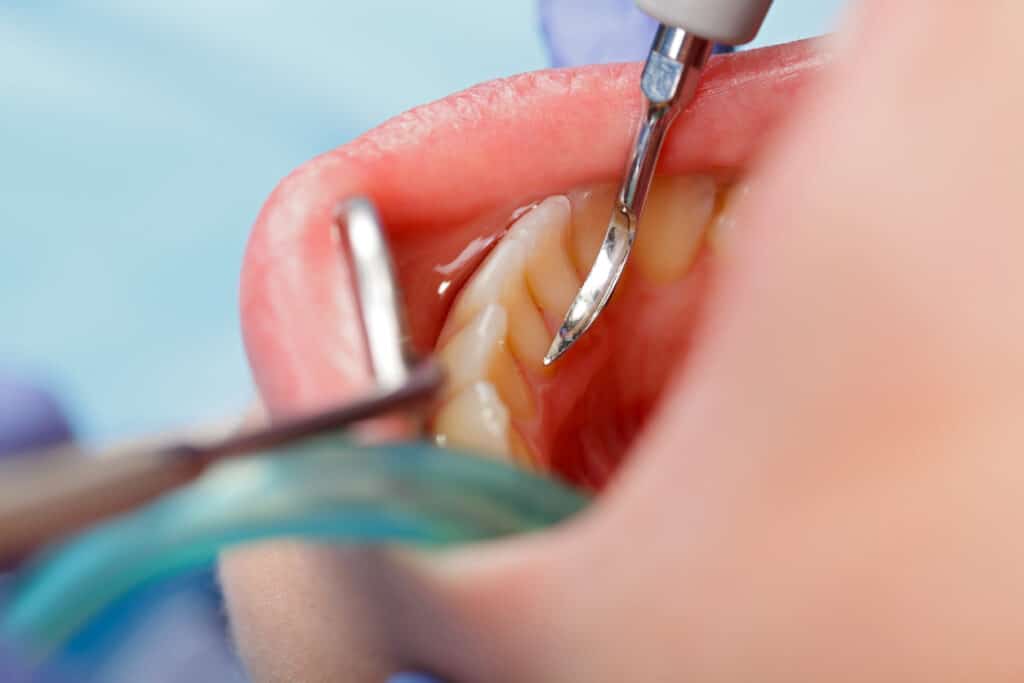
Ultrasonic teeth scaling is a state-of-the-art dental cleaning technique that uses high-frequency sound waves and water irrigation to safely break down hardened tartar on teeth. Evidence suggests removing deposits that have accumulated on the teeth through scaling and root planing [1] (Oza et al., 2022). This modern technology at Cary Towne Dental cleans deep along the gumline with minimal pressure, providing a gentle, comfortable alternative to traditional manual scraping for sensitive or overdue teeth.
The Science of Sound: Why Ultrasonic Waves Are Softer on Sensitive Teeth
Hand scaling uses physical leverage. To remove old tartar, a hygienist must push and pull a metal tool against your tooth root. If you have sensitive teeth, that physical pressure often triggers sharp zings of pain. Ultrasonic scalers solve this problem by eliminating the need for heavy force. Instead of scraping, the tool utilizes micro-vibrations. Your tooth nerves register a light, rapid hum rather than a sharp pulling sensation. This gentle vibration actually helps intercept and block pain signals from reaching your brain, making the entire cleaning process relaxing.
The Power of Water Lavage: Flushing Out Hidden Bacteria
Medical literature supports that an ultrasonic dental scaler is a valuable tool in the prevention of periodontal disease [2] (Trenter et al., 2003). As the scaler hums, it releases a continuous, cooling stream of water. In clinical dentistry, we call this fluid lavage. The bacteria that cause gum disease thrive in dark, oxygen-free spaces deep beneath your gumline. The ultrasonic water spray forces a rapid burst of oxygen and fluid directly into those hidden pockets. This targeted stream washes away the shattered tartar, neutralizes the harmful bacteria, and leaves your gums remarkably clean.
Erasing Years of Coffee and Tea Stains Without Harsh Scraping
If you drink coffee on your morning commute down SW Cary Parkway, your teeth will naturally pick up dark pigments over time. These dark stains bind tightly to the rough tartar buildup on your lower teeth. Because the ultrasonic scaler effectively shatters this calcified buildup, it also lifts away years of stubborn yellow and brown discoloration in the process. You get a cosmetic boost alongside your health upgrade. Your smile looks instantly brighter and feels remarkably smoother even before your hygienist applies the final polishing paste.
Comparisons: Modern Scaling vs. Traditional Methods
Understanding how modern cleaning technology compares to older methods makes it easy to choose the right path for your oral health.
Feature | Ultrasonic Scaling | Traditional Hand Scaling | Laser-Assisted Debridement |
Primary Mechanism | High-frequency sound waves & water cavitation | Manual stainless-steel scraping | Concentrated thermal light energy |
Patient Comfort | High; gentle vibration, no scraping pressure | Moderate to Low; noticeable pressure & friction | High; minimal sensation, highly focused |
Treatment Time | Fast; breaks down heavy calculus in 30–45 min | Slower; often takes 60+ minutes of manual work | Moderate; often paired with ultrasonic tools |
Cost Impact | Low to Moderate; standard preventive/periodontal codes | Low; standard cleaning rates | Moderate to High; often carries out-of-pocket costs |
Durability & Tissue Recovery | High; smooth surfaces slow down new tartar attachment | High; requires meticulous daily home hygiene | High; promotes fast soft-tissue reattachment |
Maintenance Level | Routine 3- to 6-month preventive visits | Routine 3- to 6-month preventive visits | Specialized 3-month periodontal tracking |
Braces, Retainers, and Tight Spaces: Who Benefits Most?
Traditional metal hand tools often struggle to navigate around orthodontic hardware or tightly crowded teeth. If you wear a fixed permanent retainer behind your bottom teeth, you already know how fast tartar builds up in that area. The slim, rounded tip of an ultrasonic device easily reaches into these tricky, narrow spaces. The sound waves navigate around your braces and wires effortlessly. This means your hygienist does not have to awkwardly maneuver sharp tools inside your mouth, giving you a superior clean in a fraction of the time.
What to Expect the Day After an Ultrasonic Clean
You might worry that removing years of heavy dental buildup will leave your mouth throbbing for a week. Fortunately, ultrasonic technology promotes very fast tissue recovery. Because the scaler relies on sound waves rather than aggressive scraping, trauma to your soft tissues is kept to an absolute minimum. You might experience a slight, temporary sensitivity to very cold drinks for 24 to 48 hours. However, you can eat, drink, and go to work normally. By the very next morning, your gums will feel tighter, firmer, and surprisingly refreshed.
FAQS
1. Can ultrasonic scaling damage my natural tooth enamel?
No. The ultrasonic tips are uniquely curved and rounded and do not possess sharp cutting edges. When calibrated by a licensed dental professional, the sound waves break apart brittle calculus deposits without scratching, cutting, or wearing away strong enamel.
2. How loud does an ultrasonic scaler get when it is running?
The instrument gives off a faint, high-pitched humming and a soft sound of running water. If you are sound sensitive, please bring your favorite earbuds to listen to music or a podcast during your appointment.
3. Can crowns, veneers, or implants be safely cleaned using ultrasonic cleaning?
Yes. When we clean around crowns, porcelain veneers, and dental implants, we change the frequency and use special, non-metallic composite or carbon-fiber tips.
References
[1] Oza, R. R., Sharma, V., Multani, P., Balsara, K., Bajaj, P., & Dhadse, P. (2022). Comparing the Effectiveness of Ultrasonic Instruments Over Manual Instruments for Scaling and Root Planing in Patients With Chronic Periodontitis: A Systematic Review and Meta-Analysis. Cureus, 14(11), e31463. https://doi.org/10.7759/cureus.31463
[2] Trenter SC, Walmsley AD. Ultrasonic dental scaler: associated hazards. J Clin Periodontol. 2003;30(2):95-101. doi:10.1034/j.1600-051x.2003.00276.x