
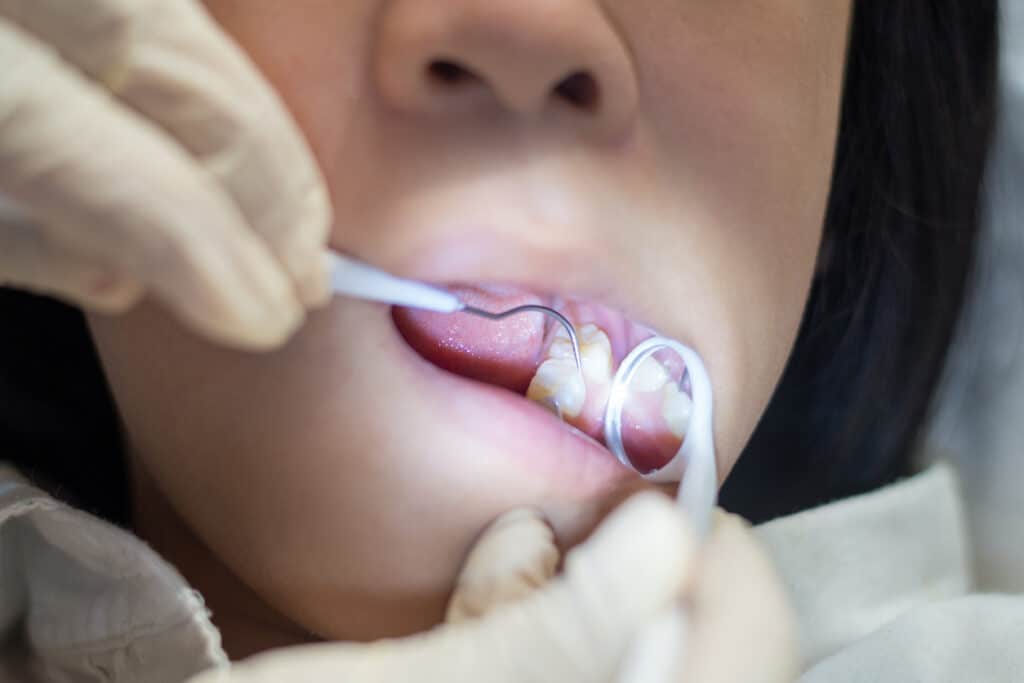
Dental sealants at Cary Towne Dental are a specialized, thin protective coating applied directly to the chewing surfaces of your back teeth to prevent decay. The American Dental Association supports the claim that dental sealants are effective in preventing pit-and-fissure caries in primary and permanent molars [1] (ADA, n.d.). This fast, painless treatment fills vulnerable grooves that toothbrushes cannot reach, blocking harmful bacteria and helping prevent future restorative dental work.
The Perfect Timeline: When Should Your Child Get Sealants?
Medical literature indicates that 41.7% of children aged 5-11 years have dental sealants [2] (NIH, 2016). As a parent, managing a busy family healthcare schedule can feel overwhelming. The optimal time to apply sealants is immediately after the permanent molars erupt into the mouth. For most children, the first set of permanent molars appears around age six, right behind their baby teeth. The second set typically arrives around age twelve. By acting quickly, you seal the tooth before it is ever exposed to the daily wear and tear of a standard diet. This proactive timing is a simple strategy to keep your child out of the restorative dental chair.
The Hidden Value of Dental Sealants for Adults
Sealants are widely known as a pediatric treatment, but they offer distinct benefits for adults as well. Over the years, changes in your diet, new daily medications, or a natural decrease in saliva production can suddenly make you more prone to cavities. If you are an adult with deep natural grooves in your teeth and no existing fillings in those areas, sealants act as a smart, affordable insurance policy. For career-focused professionals in Wake County, this quick preventive step means fewer disruptions to your busy schedule later on.
Modern, Safe Materials: What Exactly Goes on Your Tooth?
It is natural to worry about the materials used in medical treatments. You deserve complete transparency about what goes into your mouth or your child’s mouth. At Cary Towne Dental, we use top-tier, biocompatible resin coatings. These modern materials are specifically engineered to be safe, durable, and highly effective. They do not expose you to dangerous chemicals and are strictly BPA-free. The resin bonds seamlessly with your natural enamel, providing a strong, smooth surface that feels completely normal when you bite down.
Treatment Comparisons: Sealants vs. Fillings
Understanding the value of preventive dentistry is easy when you look at the alternatives. Here is how a quick sealant compares to treating a cavity after it forms.
Treatment Type | Primary Purpose | Estimated Out-of-Pocket Cost | Durability & Maintenance Level |
Dental Sealants | Proactive cavity prevention | Low ( 30– 30– 60 per tooth) | 3–5+ years; routinely checked during standard exams |
Composite Fillings | Reactive decay repair | Moderate ( 150– 150– 300+ per tooth) | 5–10+ years; requires closer monitoring for wear |
No Treatment | Wait and watch approach | Zero initial cost; high future risk | Leads to decay; requires eventual restorative work |
Post-Appointment Care: What to Expect After Receiving Sealants
Nobody wants to deal with a numb lip, pain, or strict dietary restrictions after a dental visit. Because the sealant procedure requires no drilling and no local anesthesia, there is zero recovery time. Our specialized curing light instantly hardens the material. You or your child can eat, drink, and return to school or work as soon as you leave our office. Your daily routine remains the exact same. You just continue brushing and flossing normally to keep the untreated surfaces of your teeth healthy.
Maximizing the Lifespan of Your Dental Sealants
Once your sealants are properly in place, they can protect your teeth for several years. Preventive investment: Just make the most of your preventive investment by not chewing on ice cubes, hard candies, or pen caps. These hard objects can eventually chip away at the protective resin layer. At your routine six-month visits to our Cary clinic, Dr. Pari Prahalad will visually examine your sealants. If she notices any minor wear, she can easily touch up the edges so your teeth remain fully protected.
FAQS
1. Can adults get dental sealants too?
Yes. While sealants are heavily promoted for children when their permanent molars erupt, adults can absolutely receive them. If you have deep grooves in your molars, no current decay, and no existing fillings in those teeth, sealants are a smart way to protect your mature smile.
2. How long do dental sealants last on average?
With proper brushing and a standard diet, sealants typically last between three and five years, though they can last up to a decade.
3. Are the dental sealants you use safe and BPA-free?
Patient safety is our top priority. We use modern, high-quality sealant materials that are strictly tested and completely safe.
References
[1] ADA. (n.d.). Dental sealants on teeth. In www.ada.org. Retrieved August 16, 2026, from https://www.ada.org/resources/ada-library/oral-health-topics/dental-sealants
[2] NIH. (2016). Dental sealants in children (ages 6 to 11). In Nih.gov. https://www.nidcr.nih.gov/research/data-statistics/dental-sealants/children